The romance came later
KISS1 began as a metastasis-suppressor gene in melanoma research. Kisspeptin-54 was originally called metastin. The turn toward reproduction came with loss-of-function GPR54 mutations and failure of puberty in humans; mice lacking that receptor reproduced the phenotype. A name that sounds playful led to a biological requirement.
The genetic clue is my favorite turn in this story. I admire how much the genetics established: removing a working receptor disrupted reproductive maturation. It did not establish that adding more peptide improves every aspect of adult sexual life.
KISS1R and GPR54 name the same receptor. The KISS1 precursor contains 145 amino acids and is processed into kisspeptin-54 and shorter fragments, including KP-14, KP-13 and KP-10. The fragments share an RF-amide ending needed for receptor binding. The clinical-status review surveys the family and its investigational applications; no kisspeptin product has regulatory approval.
Puberty supplied the decisive clue
Kisspeptin acts on neurons that release GnRH, the hormone signal sent from the hypothalamus to the pituitary. The pituitary releases LH and FSH, and those hormones stimulate the gonads. Kisspeptin prompts this system; it does not supply testosterone or estrogen.
The cellular detail is unusually tangible. In mouse GnRH-neuron recordings, 100 nM kisspeptin depolarized the neurons by 6 ± 1 mV and increased firing rate by 87 ± 4%. A phospholipase C/calcium pathway changed ion-channel activity so the neurons could fire. These in vitro measurements concerned mouse neurons; a person's desire was outside the experiment's scope.
I enjoy the precision of that experiment. A cell's electrical response is a result with a clear address, and the paper identifies the machinery behind it. The human and mouse GPR54 genetics supplies a different kind of evidence for why that machinery matters.
The pulse returned—and the response could fade
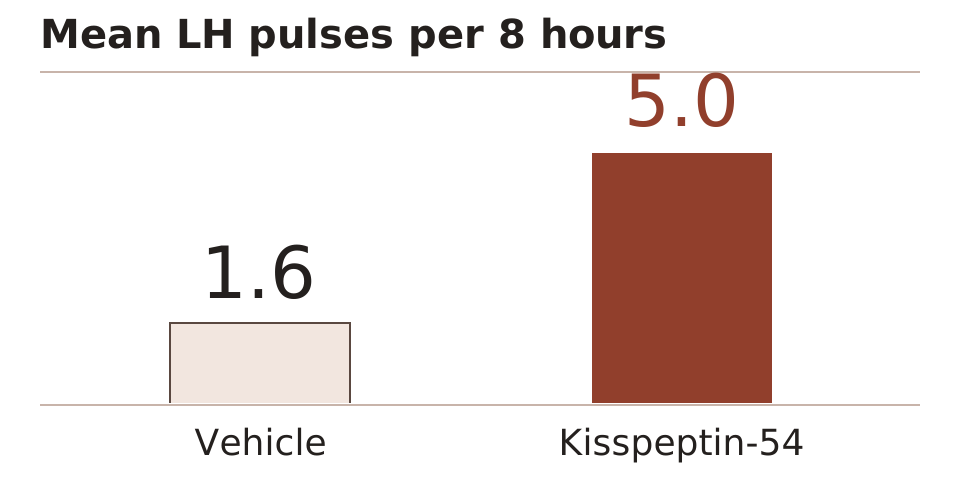
In five women with hypothalamic amenorrhea, where menstrual periods had stopped through suppression of reproductive signaling, intravenous kisspeptin-54 increased LH pulses from 1.6 to 5.0 per 8 hours compared with vehicle. Pulse secretory mass rose from 3.92 to 23.44 IU/L. The research infusion range was 0.01 to 1.00 nmol/kg/h.
The highest infusion rate also produced tachyphylaxis—a diminishing response during continued exposure. I count that diminishing response among the findings. The experiment restored pulsatility and revealed a limit on sustaining the response.
The kisspeptin-10 study in healthy men adds another setting. A 1 µg/kg intravenous bolus produced an LH peak from 4.1 to 12.4 IU/L at 30 minutes. An infusion at 4 µg/kg/h raised serum testosterone from 16.6 to 24.0 nmol/L, and LH pulse frequency increased from 0.7 to 1.0 pulses/h. These amounts and outcomes describe monitored research protocols only; personal dosing instructions and promised changes in libido are outside their scope.
An IVF result worth taking seriously
Ovarian hyperstimulation syndrome, or OHSS, is a potentially serious complication of fertility treatment. In the randomized Phase 2 IVF trial, 60 women at high risk of OHSS received subcutaneous kisspeptin-54 in study doses of 3.2 to 12.8 nmol/kg. Oocyte maturation occurred in 95% of participants, with no moderate, severe or critical OHSS. The highest live-birth rate, 62%, followed the 9.6 nmol/kg study dose.
That specificity earns my respect: the investigators chose a specific problem, tested a concrete outcome and followed it beyond a hormone rise. My enthusiasm stops at the study boundary. A result in this fertility protocol cannot establish the safety of all future exposures, and it has not become an approved kisspeptin treatment.
The nose became another research route
The 2025 intranasal kisspeptin-54 study reported rapid LH stimulation after a primary study dose of 12.8 nmol/kg: +4.4 IU/L in healthy men, +1.4 IU/L in healthy women and +4.4 IU/L in women with hypothalamic amenorrhea. No adverse events were reported, and the formulation remained stable for up to 60 days at 4 degrees C.
I see the delivery result as a useful development. It opens a non-invasive route for investigation. Short-term tolerability and formulation stability leave the much larger questions about repeated exposure and long-term safety unanswered.
The 2025 systematic review identified 29 interventional clinical trials after searching databases through February 2023. Its applications include amenorrhea, puberty, ovarian function and fertility. The publication year does not turn that search cutoff into a census of every later trial.
Kisspeptin antibody, KISS1R antibody, KISS1R ELISA kit
These searches bring laboratory questions onto the same page as therapeutic ones. A kisspeptin antibody search concerns the peptide; KISS1R antibody and KISS1R ELISA kit searches concern its receptor. The receptor is also called GPR54.
This site does not evaluate individual antibodies or assay kits. The cited studies do not provide a product comparison or validate every item bearing those names. An assay query and a kisspeptin research peptide query need different answers; neither establishes an approved treatment.
Affectionate accounts, less affectionate uncertainties
Community accounts describe increased sexual interest, emotional closeness or spontaneous erections. Other accounts describe no perceptible effect, fading effects, flushing, headache, nausea or lightheadedness, and uncertainty over whether material is kisspeptin-10 or kisspeptin-54. These are anecdotal accounts, not clinical evidence; they cannot supply a response rate or a safety estimate.
I'm unconvinced by the leap from an LH rise to a reliable feeling of intimacy. The LH-pulsatility experiment measured hormones; relationships were outside its scope. The clinical-status review describes an investigational field whose human data come from supervised research rather than verified safety of research-labelled material.
The cautions extend beyond fading responses. Effects in hormone-sensitive conditions and alongside hormonal therapy remain uncharacterized. Exogenous kisspeptin's effects in pregnancy are uncharacterized, despite high placental expression. The existing safety record also flags vasoconstriction and accelerated plaque progression in a mouse model; that is an animal signal, not established cardiovascular harm in humans. Short exposures do not settle long-term safety.
A multicenter replication would be a better reason for my enthusiasm than another appealing nickname. The comparison with PT-141 explains why a desire result and a reproductive hormone result cannot be exchanged as if they were the same currency.